

BI & Analytics
Democratizing BI in Regulated Industries:
Balancing Compliance, Security, and Usability at Enterprise Scale
Read Time : 4 min
Download PDFIn regulated industries, Business Intelligence (BI) is no longer a reporting utility it is a strategic control system. For banks, healthcare providers, insurers, and telecommunications enterprises, data drives operational efficiency, risk management, fraud detection, regulatory reporting, and customer intelligence. At the same time, that data introduces significant responsibility. Compliance violations, cybersecurity breaches, and governance failures can result in financial penalties and reputational damage
The question is no longer whether organizations should democratize BI. The real challenge is how to enable broader access to insights while preserving compliance, strengthening security, and maintaining governance integrity. Achieving this balance requires architectural discipline not simply better dashboards.
Why Democratizing BI Is Essential in Regulated Environments
Modern enterprises operate in real time. Treasury teams require immediate liquidity visibility. Risk teams monitor live transaction anomalies. Operations leaders depend on continuous performance tracking. Traditional centralized analytics models create bottlenecks, delaying decision-making and reducing agility. Democratized BI empowers business users with timely, role-specific access to trusted data, enabling faster and more informed decisions.
However, in regulated sectors, unrestricted access to data introduces systemic risk. Sensitive financial records, personal health information, and confidential customer data must remain protected under strict regulatory mandates. Democratization, therefore, must be governed not open-ended. It must be intentional, policy-driven, and aligned with compliance frameworks.
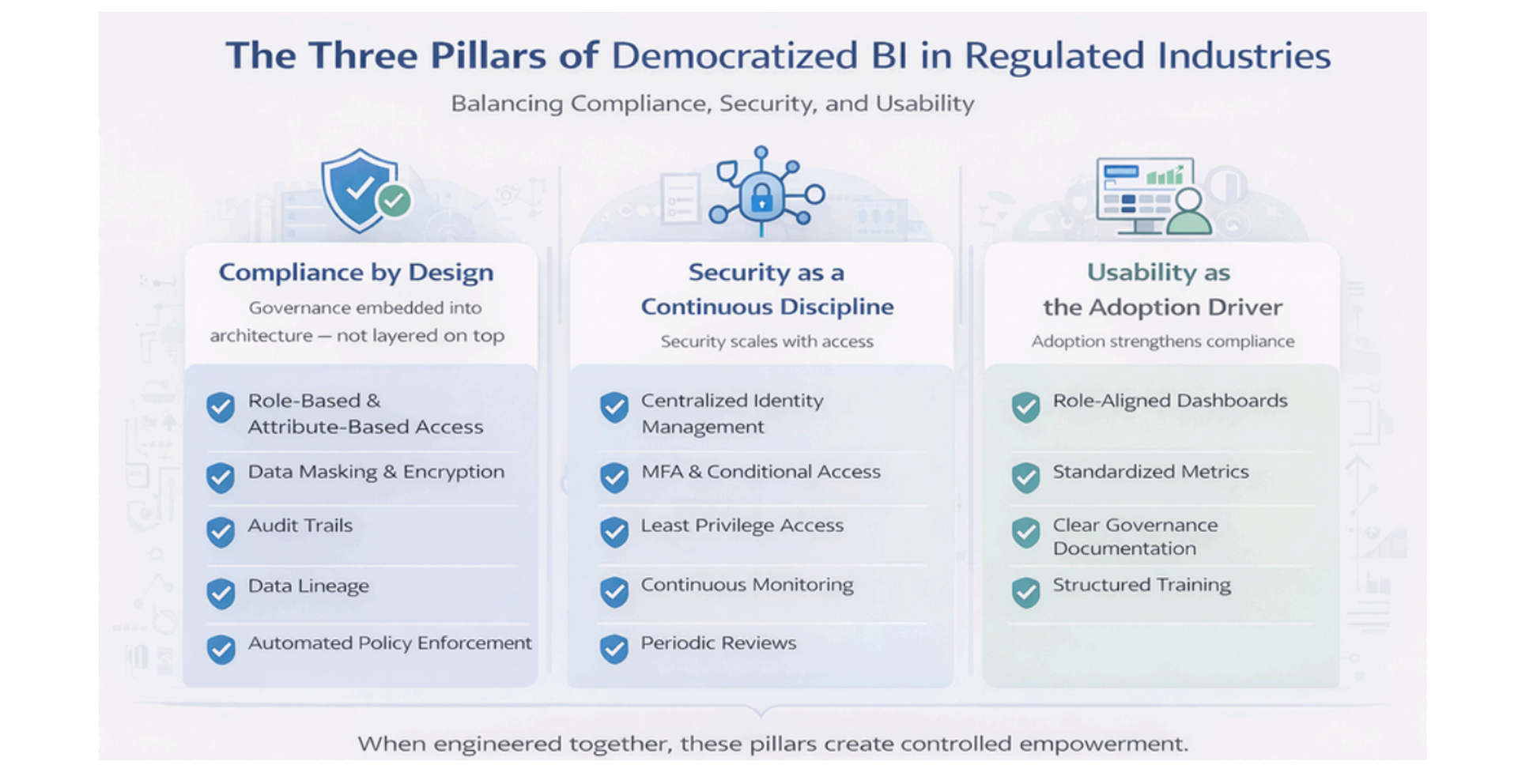
Compliance by Design: Engineering Governance into BI Architecture
Regulatory frameworks such as GDPR, HIPAA, PCI-DSS, and sector-specific supervisory guidelines require transparency, traceability, and accountability. Compliance cannot be treated as an afterthought layered onto analytics platforms. It must be embedded at the architectural level.
A mature, compliant BI framework includes:
- ⚫Clearly defined role-based and attribute-based access controls aligned with job responsibilities
- ⚫Data masking and encryption to protect sensitive information in transit and at rest
- ⚫Comprehensive audit trails to ensure traceability of user activity
- ⚫End-to-end data lineage to provide visibility into how data is sourced, transformed, and reported
- ⚫Automated enforcement of governance policies within data pipelines
When compliance is built into system design, it becomes scalable and sustainable. Organizations reduce regulatory exposure while enhancing transparency and operational confidence.
Security as a Continuous Enterprise Discipline
As BI access expands, so does the potential attack surface. Security in a democratized BI environment must function as a continuous, organization-wide discipline rather than a one-time implementation. A secure enterprise BI ecosystem incorporates:
- ⚫Centralized identity and authentication management
- ⚫Multi-factor authentication and conditional access policies
- ⚫Granular, least-privilege permission structures
- ⚫Continuous monitoring and anomaly detection
- ⚫Periodic access reviews and validation processes
Cloud-based BI platforms can strengthen security posture when properly configured, offering enterprisegrade encryption and automated updates. However, long-term protection depends on governance oversight
and proactive risk management.
In regulated industries, security is not solely an IT function it is a strategic business imperative.
Usability: The Critical Driver of Adoption
While compliance and security are foundational, usability determines whether democratized BI succeeds in practice. Overly complex systems or excessive restrictions can discourage adoption. When business users find tools difficult to navigate, they may revert to manual reporting or unsanctioned solutions, inadvertently increasing risk.
Effective democratization requires:
- ⚫Intuitive, role-aligned dashboards
- ⚫Standardized data models that ensure consistent metrics
- ⚫Clear documentation of definitions and governance standards
- ⚫Structured training and enablement programs
When users understand both the data and the guardrails governing it, adoption improves and compliance is reinforced. Usability and governance are not opposing forces. When aligned properly, they strengthen each other.
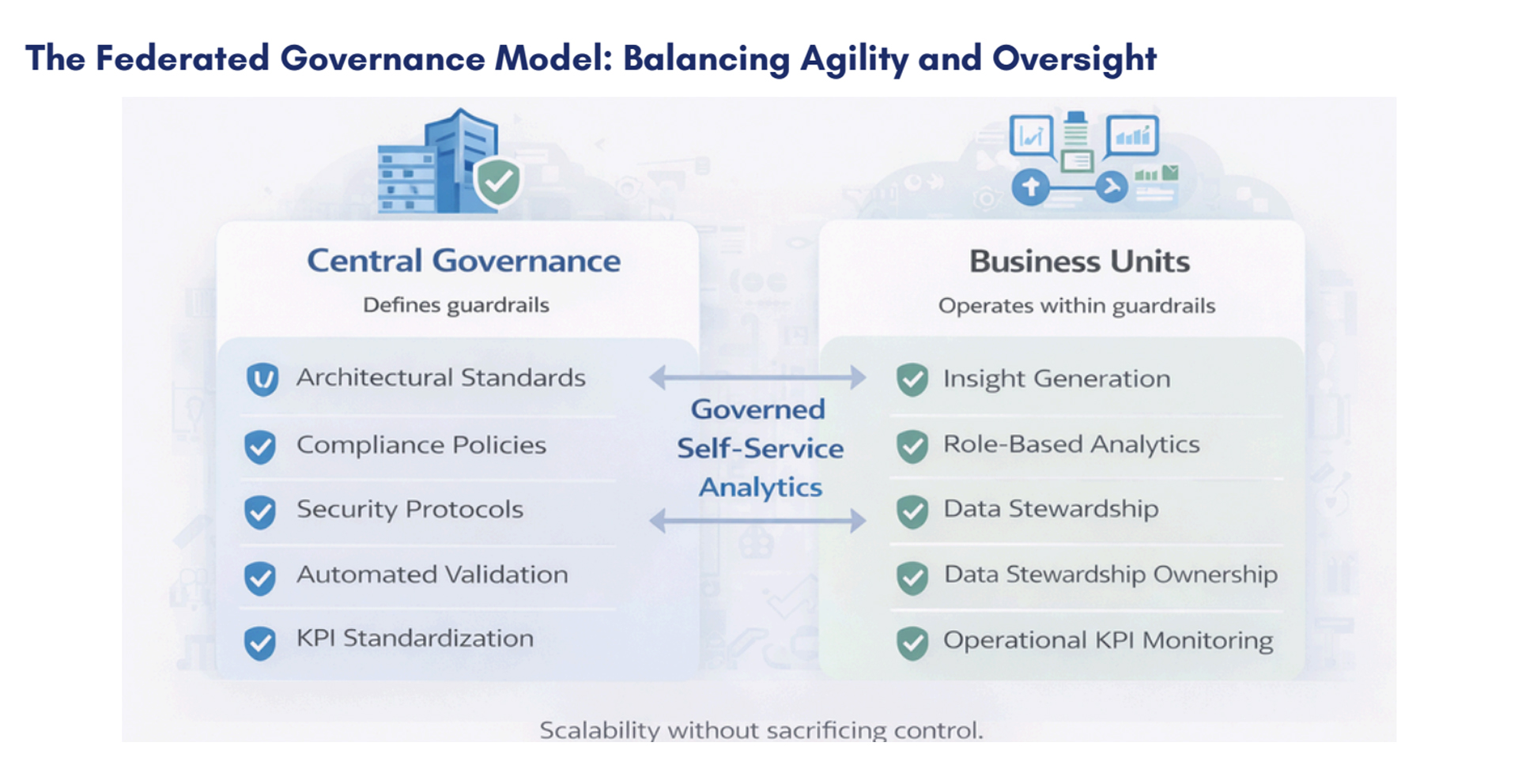
Leading regulated enterprises implement federated governance frameworks that combine centralized control with distributed autonomy.
In this model:
- ⚫Central governance teams define architectural standards, compliance policies, and security protocols
- ⚫Business units operate within those defined parameters to generate insights
- ⚫Data stewardship programs assign ownership and accountability
- ⚫Automated validation processes ensure data integrity
- ⚫Standardized KPI frameworks prevent inconsistent reporting
This balanced approach enables scalability without sacrificing control. Governance becomes integrated into daily workflows rather than treated as an administrative burden.

Strategic Outcomes of Responsible BI Democratization
When compliance engineering, security frameworks, and usability design are harmonized, organizations realize measurable benefits:
- ⚫Faster, data-driven decision-making across departments
- ⚫Reduced dependency on manual reporting processes
- ⚫Enhanced audit readiness and regulatory transparency
- ⚫Improved operational efficiency
- ⚫Strengthened stakeholder and customer trust
In regulated industries, trust is foundational. A well-architected BI strategy reinforces that trust while empowering innovation.
AION-TECH’s Approach to Secure and Compliant BI Transformation
At AION-TECH, we design and implement Business Intelligence ecosystems that balance innovation with regulatory discipline. Our approach integrates compliant architecture, enterprise-grade security controls, and governed self-service analytics to help regulated enterprises modernize with confidence. By embedding data governance and scalable integration into the foundation of BI environments, we enable organizations to accelerate insight generation while maintaining full compliance and operational integrity.

The Future: Controlled Empowerment
The future of BI in regulated industries lies in controlled empowerment where data is accessible, protected,
and actionable within intelligent guardrails. Organizations that master this equilibrium will not only meet
regulatory expectations but also unlock strategic advantage in an increasingly data-driven and complianceintensive landscape
Democratization, when engineered responsibly, is not a risk. It is a competitive differentiator.